

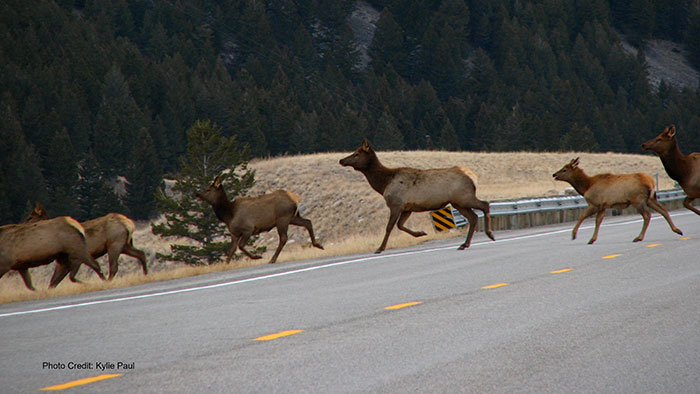
Elk crossing the road. Photo credit: Kylie Paul
Sixmile Creek Wildlife Crossings Project
The Sixmile Creek Underpass project replaces a 60-year-old culvert with two bridges, one each direction, on Interstate 90 (I-90), which will serve as a wildlife underpass. Sixmile Creek is located approximately at RP 83.5 on I-90 in Missoula County. Combined with the underpass, the project includes stream restoration of Sixmile Creek to improve fish passage, wildlife exclusion fence, jump-outs, cattle guards and/or electric mats, and signing. The full project target area includes wildlife exclusion fence from approximately RP 79.3-86.6, which includes fencing to two existing bridges over the Clark Fork River that will serve as additional underpasses. Some work may be required under these structures to enhance wildlife crossing opportunities.
The purpose of the project is to reduce wildlife vehicle collisions (WVCs) and enhance habitat and wildlife connectivity by keeping wildlife off the highway and guiding them towards the safe crossing opportunities provided by the new and existing structures. The Ninemile and Sixmile areas are important wildlife movement corridors south to the Bitterroot Mountains. Increasing traffic volume on I-90 and expanding development in the Missoula and surrounding valleys, present significant challenges for wildlife and risk to drivers. Roughly 34% of all highway accidents in this area are attributed to WVCs, compared to an average of 10% across Montana.
The project was proposed by the Western Montana Wildlife Connectivity Group, (formerly the Missoula Regional Connectivity Group) through the Project Program in 2023. The project is currently in a feasibility study to evaluate the construction of wildlife underpass, as well as the exact size, dimensions, and details of these structures. The study will evaluate placement of fencing, cattle guards, and electric mats to keep wildlife from entering the corridor, as well as jump-outs to allow animals to safely escape. The feasibility study is anticipated to be completed in the Fall of 2026. Please visit the project webpage for more information.
Dome Mountain Wildlife Crossing Project
The Dome Mountain project includes two wildlife overpasses near RP 19.3–19.5 and RP 17.6–18.5 on US-89 in Park County. Combined with the two overpasses, the project includes a reconfiguration of riprap under the Point of Rocks bridge, wildlife exclusion fence, jump-outs, cattle guards and/or electric mats, and signing. The full project target area includes wildlife exclusion fence from approximately RP 16.5-22.0.
The purpose of the project is to reduce wildlife vehicle collisions (WVCs) and enhance habitat and wildlife connectivity by keeping wildlife off the highway and guiding them towards the safe crossing opportunities provided by the structures. US-89 and the Dome Mountain area is an important wildlife movement corridor and with the increasing traffic volume, presents a significant risk to drivers and wildlife. Roughly 50% of all highway accidents along US-89 are attributed to WVCs, compared to an average of 10% across Montana.
The project is currently in a feasibility study to evaluate the construction of two wildlife overpasses, the exact locations, as well as, the size, dimensions, and details of these structures. The study will evaluate placement of fencing, cattle guards, and electric mats to keep wildlife from entering the corridor, as well as jump-outs to allow animals to safely escape.
The project was proposed by Yellowstone Safe Passages through the Project Program in 2024. The feasibility study is anticipated to be completed in the Summer of 2027. As the project progresses, a project webpage will be developed and linked here when it is available.
Mouth of Gallatin Canyon Wildlife Crossing Project
The Mouth of Gallatin Canyon project includes a set of wildlife structures, an underpass, overpass, and bridge retrofit, near the mouth of Gallatin Canyon between approximate RP 70-73 on US-191 in Gallatin County. Combined with the structures, the project includes wildlife exclusion fence, jump-outs, cattle guards and/or electric mats, and signing.
The purpose of the project is to reduce wildlife vehicle collisions (WVCs) and enhance habitat and wildlife connectivity by keeping wildlife off the highway and guiding them towards the safe crossing opportunities provided by the structures. US-191 and the area around the mouth of the canyon serves as important daily and seasonal wildlife habitat and with the increasing traffic volume, presents a significant risk to drivers and wildlife. Roughly 24% of all highway accidents in the area are attributed to WVCs, compared to an average of 10% across Montana.
The project was proposed by Center for Large Landscape Conservation (CLLC) through the Project Program in 2024. A feasibility study evaluating the construction of the wildlife structures and bridge retrofit was funded by CLLC and completed by a consultant in 2024. The study resulted in a constructable project with an estimated construction cost of $26,000,000. CLLC currently holds pledges of over $3,000,000 to provide match funds required for future grant or other funding opportunities.
North of Big Sky Wildlife Crossing Project
The project on US-191 north of Big Sky in Gallatin County includes a wildlife overpass near RP 49 connected, with wildlife exclusion fence to the existing Jack Smith and West Fork bridges, which will function as underpasses. Some riprap reconfiguration under the bridges may be required to provide adequate wildlife pathways under US-191. Combined with the structures and wildlife exclusion fence, the project includes jump-outs, cattle guards and/or electric mats, and signing.
The purpose of the project is to reduce wildlife vehicle collisions (WVCs) and enhance habitat and wildlife connectivity by keeping wildlife off the highway and guiding them towards the safe crossing opportunities provided by the structures. US-191 and the area around Big Sky serves as important daily and seasonal wildlife habitat and with the increasing traffic volume, presents a significant risk to drivers and wildlife. Roughly 24% of all highway accidents in the area are attributed to WVCs, compared to an average of 10% across Montana.
The project was proposed by the Center for Large Landscape Conservation (CLLC) through the Project Program in 2024. A feasibility study evaluating the construction of the wildlife structures and bridge retrofit was funded by CLLC and completed in 2024 by a consultant. The estimated construction cost is $21,000,000. Land ownership challenges remain and must be resolved before the project will advance to design and construction.